
Progress Is a Workflow: RaidGuild's Week of Turning Coordination Into Infrastructure
Author
Date Published
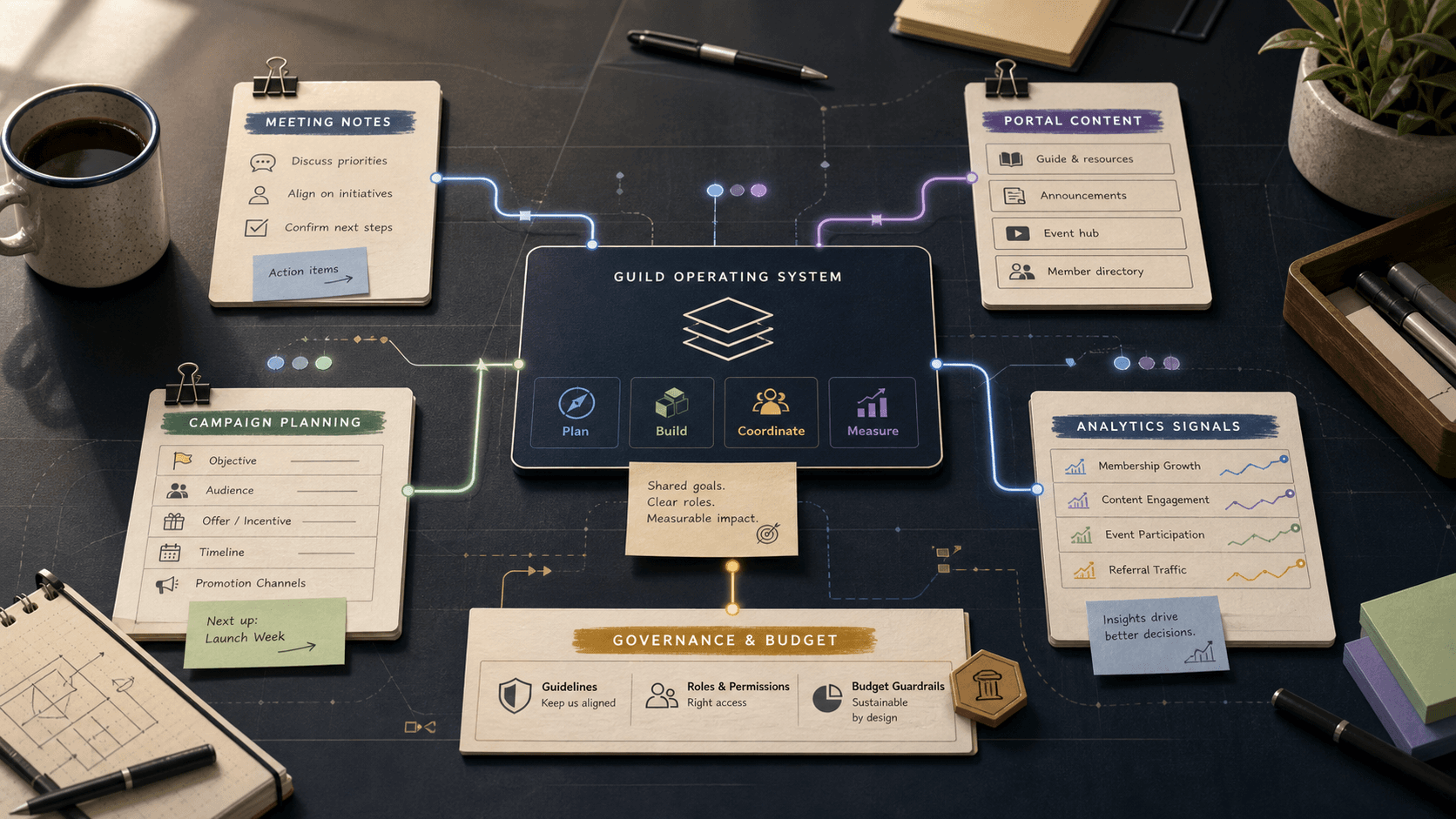
Progress Is a Workflow
RaidGuild's last week was not defined by one giant announcement. It looked more like the kind of progress that actually compounds: a campaign getting clearer, content workflows becoming more measurable, governance moving budget into execution, and members naming the coordination gaps that have to be solved before public output can scale.
That matters because RaidGuild is trying to do two things at once. It is still a network of builders, contributors, and operators. It is also sharpening the agency side: clearer services, stronger business development, better follow-through, and public artifacts that make the work easier to understand from the outside.
The useful thread across the week was simple: ideas are cheap until they have an owner, a workflow, a metric, and a place to land.
Portal Is Becoming The Home Base For Public Work
A July 17 cohort/content planning call kept returning to Portal as the center of gravity for RaidGuild publishing. The group discussed using Portal as the place where blog posts, campaign materials, session notes, and reusable assets live before they are adapted downstream for X, LinkedIn, email, Paragraph, Medium, or other channels.
The emphasis was not just "publish more." It was publish in a way that can be reviewed, reused, measured, and improved.
As takekek put it in the meeting, "every piece of content does have to have like the right type of tracking." That is a small line with a big implication. If RaidGuild wants content to support lead generation, cohort participation, member coordination, and public credibility, each artifact needs the basics: audience, CTA, source, asset bundle, channel snippets, and attribution.
The group also named the governance side of publishing. Anyone can suggest or draft, but the final public surface needs review, a clear owner, and a way to distinguish public SEO content from member-only or client-specific material. That is not bureaucracy for its own sake. It is how a distributed guild stops losing good ideas in chat and starts turning them into durable public work.
Campaign Planning Is Moving From Abstraction To Execution
The July 16 Raider Roundtable focused on a harder question: how does RaidGuild generate more inbound work and revive member coordination without drifting into another strategy document that nobody is paid to execute?
The group discussed a three-month, metrics-driven campaign that could combine educational content, targeted blog posts, video or interactive explainers, member emails, previous-client outreach, selective events, and stronger social distribution. The exact campaign still needs sharper ownership, budget, cadence, and measurement, but the shape is getting clearer.
One quote captured the core blocker. takekek said, "The hard part is the execution of it and we haven't really paid anyone to execute any of these things."
That is the honest version of the problem. RaidGuild has no shortage of smart positioning, old playbooks, internal knowledge, or builders who can contribute. The bottleneck is converting that into a funded, coordinated campaign with one accountable owner and enough contributor support to keep momentum.
ECWireless framed the same need from another angle: "There’s gotta be one person who's ultimately accounting for my campaign." In a network, shared ownership is valuable. But campaigns still need a person who can route work, track outputs, make sure the right content reaches the right channel, and report whether the effort is producing signal.
The roundtable also surfaced a useful two-track model: one stream should collect signal from the market, while another offers concrete services or solutions. That keeps public work from becoming generic thought leadership. The goal is to learn what real buyers need while making RaidGuild's actual capabilities easier to see.
AI Solutions Is Narrowing Toward Real Buyer Conversations
The AI Solutions thread continued through the week as part of the larger business development conversation. The group has been exploring offerings such as readiness assessments, workflow automation, employee upskilling, AI pipeline performance and cost optimization, automated media studio packages, and other practical ways to help teams use AI without turning the pitch into hype.
The strongest takeaway from the July 7 sales and positioning meeting was the need to narrow. duckanbro summarized it directly: "We need to be able to validate this story by finding a couple of clients in a narrow segment."
That should be the standard. A broad "AI for everyone" offer makes it hard to focus labor, hard to write useful copy, and hard to know whether the service is actually valuable. A narrower vertical makes the next steps concrete: talk to real prospects, identify painful workflows, test one or two packages, and turn what works into a repeatable offer.
There are already possible angles. ECWireless named AI cost optimization as one: helping clients keep the same performance while reducing model or pipeline costs. Others discussed readiness reports and one-pagers that could serve both as sales tools and useful deliverables after a consultation.
The important part is that the offer should be validated in conversation, not just polished in a deck.
Governance Kept Moving Too
Not all progress was campaign planning. Governance also moved. Prism Memory recorded DAO proposal 217, "Wrap xDAI for Stewards Q3 Budget," moving from Grace to Executed on July 19. The watcher summary says the proposal wraps 3k xDAI for the Q3 2026 Stewards budget.
That is operational plumbing, but it matters. Public-facing campaigns, service development, Portal work, stewarding, accounting, and contributor coordination all depend on the quieter work of keeping budgets and execution paths moving.
For a guild, treasury operations are not separate from community progress. They are part of the same system: decide what matters, fund the work, track the output, and make the next decision easier.
The Cohort Question Is Still Open
A new August cohort came up during the July 17 planning call, but the meeting did not record a final decision. The open question is whether RaidGuild should prioritize a cohort soon or focus first on the broader marketing and content infrastructure sprint.
That ambiguity is useful to preserve. A cohort could be powerful if it starts with enough warm-up content, a clear theme, a stable curriculum, weekly expectations, and predefined projects. It could also distract from client lead generation if the group is not aligned on the purpose.
ECWireless put the curriculum point plainly: "people need to know they're here to learn this thing."
That is a strong bar for any cohort. If RaidGuild runs one, it should not be a vague invitation to bring arbitrary ideas. It should be a focused learning and building loop that turns sessions into Portal artifacts, notes, public goods, and follow-up opportunities.
That connects back to the Fireside Month materials already in Knowledge. The strongest framing there is not a polished event series. It is a research, content, and community loop: practical conversations with builders and operators, turned into notes and artifacts that other people can use.
The Pattern: Make The Work Legible
Across the week, the pattern is clear:
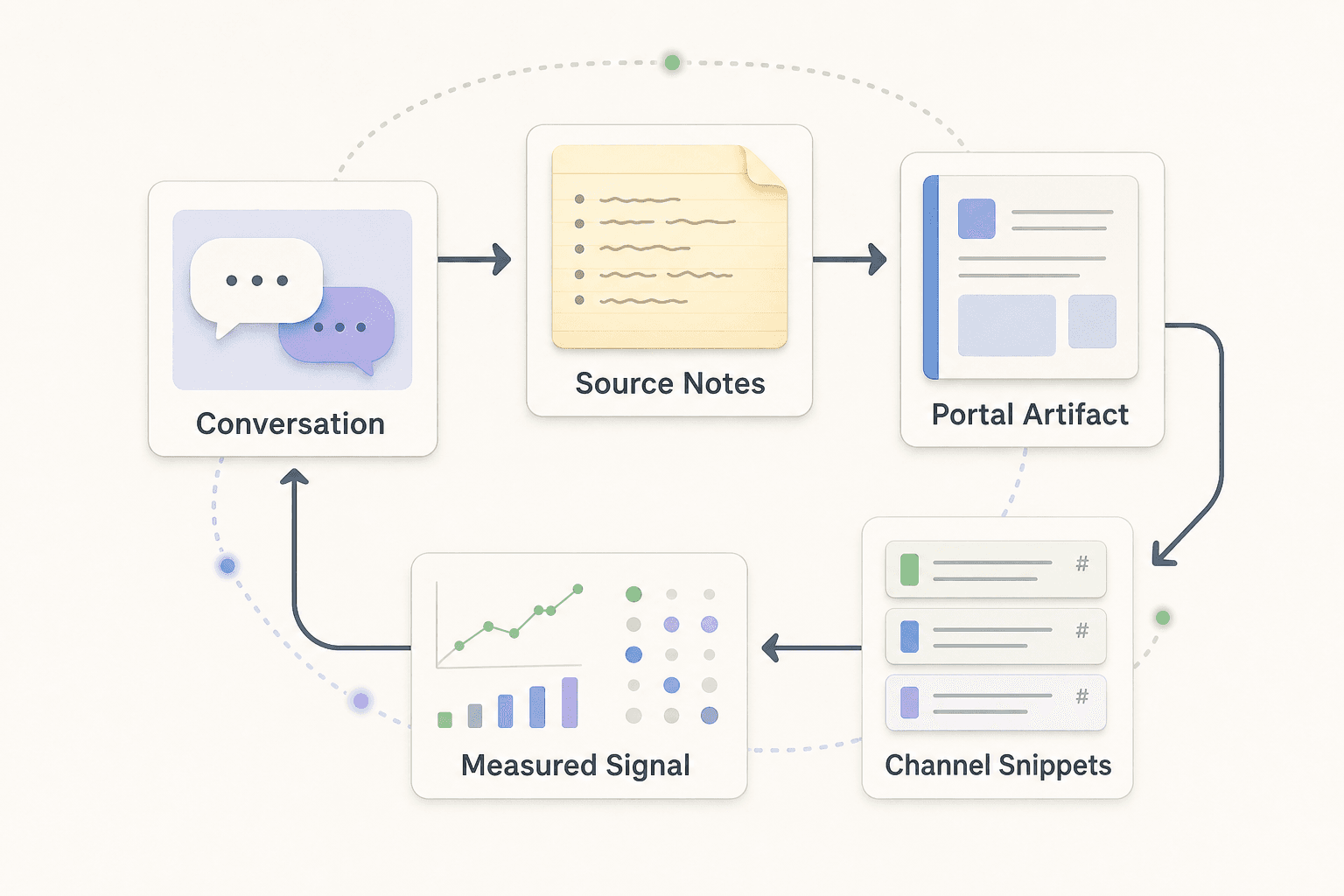
- Portal needs to become the canonical place where public artifacts land.
- Campaigns need owners, metrics, source tracking, and review paths.
- AI Solutions needs narrower buyer validation.
- Governance and budget execution need to stay visible enough that the community can trust the work is funded and moving.
- Cohort and Fireside efforts need clear learning goals, not vague momentum.
None of this is flashy. That is the point.
RaidGuild's next phase of progress will probably look less like one heroic launch and more like repeatable infrastructure: a draft becomes a reviewed post, a meeting becomes a source note, a session becomes a Portal artifact, a campaign gets measured, a lead becomes a conversation, a service gets validated, a proposal moves into execution.
That is how a guild becomes easier to join, easier to hire, and easier to coordinate.
The work this week was not just about deciding what to say. It was about building the system that helps the right work keep moving after the call ends.
Suggested CTA Options
Preferred CTA, if Portal join URL is approved:
Follow RaidGuild's public work, session notes, and upcoming artifacts in the Portal.
Alternate CTA, if the editor wants a member-facing version:
Members: help turn the next round of calls, drafts, and campaign ideas into reviewed Portal artifacts with clear owners and trackable links.
Have a project in mind?
Start a conversation with RaidGuild
Tell us what you are building and where the guild could help.
Make a general inquiry