
puddle: following a blob down a tower (field note)
Author
DekanDate Published
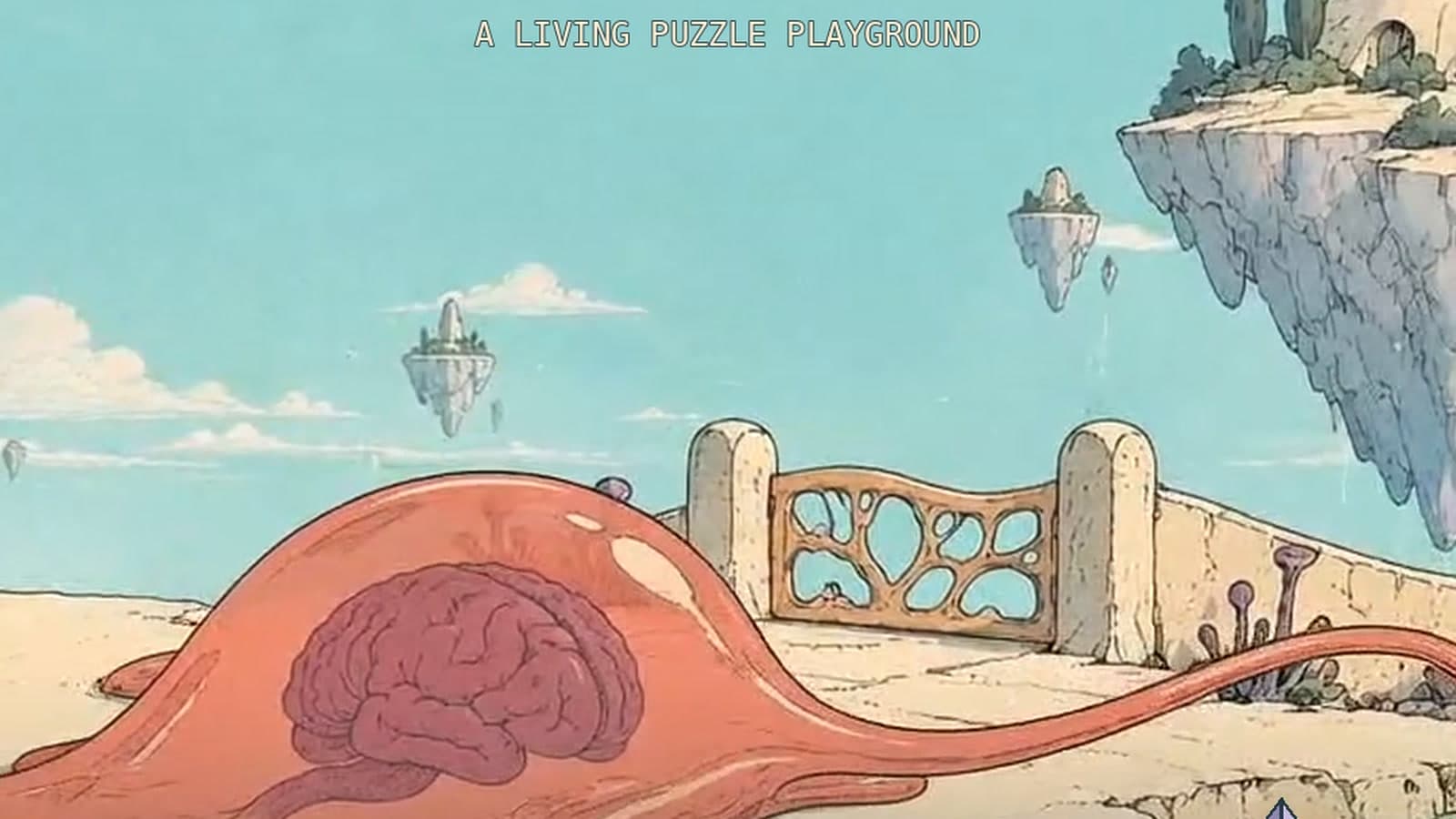
i built puddle for arcade alchemy, the raidguild cohort's month of game experiments about remixing old game mechanics with ai-assisted tools. it's playable now in the browser: play puddle. it's still a work in progress. this is a note on how it got here, and what the feedback keeps telling me.
the short version: i didn't start with a game. i started with a question about physics games: what's fun to push, stretch, knock over, or just watch react? the material kept suggesting the mechanics, and i kept following it.
it started as a pile of experiments
the first stretch covered ragdolls, soft bodies, and particle materials, each as its own experiment. ragdoll lab had drops, stairs, bowling, and collision cascades. jelly garden was springy shapes that squash when they land. powder was paintable materials and reactions. none of these are earlier versions of puddle, just separate studies to find what felt good to mess with.
the one i kept coming back to was a little puddle.
the living puddle
the setup is simple. there's a small internal brain with a body of flesh particles around it. move the brain and the connected material comes along. loose pools can join the body, so your size and your connected mass change while you play.
the early material studies each isolated one thing: gathering, growing, squeezing under a low gap, moving around obstacles. honestly, watching the body deform was satisfying enough to keep going.
turning the body into a tool
next step was making the body do things. contracting forms a mound, and releasing lets it flatten back out. shedding leaves part of you behind, so real deposited flesh can weigh down a pressure plate. tendrils stretch existing flesh out to reach and pull back loose material.
the rule that holds it together is that the body is finite. none of these actions make extra mass, they only move what you have around.
the controls changed a lot once i actually played them. at first one tendril had to come back all the way before you could cast another, and that felt restrictive. so it moved to up to three strands, tap to start or pause recall, hold to contract. no big insight there: play it, name the friction, try a change. that loop did most of the work.
giving the motion a point
gold and big violet gems gave it goals. gold gets picked up by living flesh as you pass over it. gems need sustained coverage around and above them, which is what finally made wrapping and contracting matter.
the early finish marker turned into a drain. your pink flesh streams down it into the next level's start up high, which sells the feeling that you're working your way down through a tower.
gathering garden became the tutorial: follow a trail of collectibles, gather loose pools, learn to absorb a gem, squeeze through some obstacles, get to the exit. the plan was three levels at first. it's seven now.
building the tower
the layouts grew into terraces, switchbacks, exposed ledges, narrow bridges, and tunnels. the reference i had in mind was the spatial feel of a marble madness style course: you can see the elevation, there are risky routes, and shortcuts can cost you collectibles. starts are at the top and you're always heading down.
roughly how the levels split up:
- weight garden and passage garden — pressure puzzles
- reach garden — tendrils
- grip garden — sticky climbing surfaces and slippery patches
- hollow crown — a bigger vertical course with a high bridge, a tunnel, a climbable reward platform, and recovery routes
- ember cascade — three bridges over a wide lava field, plus two bottomless pits
lava burns flesh away bit by bit, with flashes and smoke. a lethal burn or a pit sends you back to the start, but you keep what you've collected and the timer keeps running. scoring is 80 points from collectibles, plus a 20-point bonus that's all-or-nothing for finishing under the target time. unlocking the next level needs at least half the gems and gold. the time bonus doesn't count toward that.
the physics is deliberately approximate. think playful material sim, not accurate fluid. performance tuning has come up again and again, especially with loose or shed flesh lying around, and i can't promise a fixed framerate across devices yet.
look and sound
the visual target is a pale floating tower: organic arches, pierced stone, coral growth, a turquoise sky, ink-like surface detail. generated concept art helped pin that down, and modeled scenery and textures have brought parts of it into the playable scene. to be clear, the illustration and the current gameplay aren't the same thing yet. more visual work is planned.
the soundtrack, soft signal, started as a music study and ended up being the game's track. it's an original synthesized web audio piece, about 87 seconds at 88 bpm, built around a recurring D–A–B♭–E–D hook. it has eight mixable layers, including a wordless vocal bridge, guitar fills, and a solo, and every one of those timbres is synthesized. no recorded singers or guitarists. its listening app keeps the mixer, mood variations, and wav export. the game uses the "exploring" mix. the moods are authoring options, not an adaptive soundtrack.
opening it up to builders
the level workshop started as a limited layout tool and is now a 3d editor with blank and campaign presets, blocks, pillars, ramps, low gaps, paintable surfaces, pits, and freely rotated subtractive cutters for punching holes and tunnels. you can save local levels and play them in the full game.
on top of that there's a builder kit for local coding agents. it includes a skill, templates, format guidance, and a validator. the agent writes a portable json level file, and you import it, play-test it, and save it. no hosted level service is involved, just files. one caveat: the validator checks structure, not whether the puzzle can actually be solved. that part is still on you to play.
there's no community level gallery, no cloud saves, and no automatic agent-to-browser connection in this version.
what the feedback keeps saying
across the cohort's game experiments, the feedback has been pretty consistent. the speed is impressive: ai-assisted tools take an idea to real mechanics, and then to a full game, really fast. people like puddle's liquid, particle-physics feel, the way the body squishes and stretches and pours.
what still lacks is level design. the levels don't have much feeling or continuity. that seems to be the part where ai struggles, and it needs more human love. a validator can tell you a level is well formed, but not whether it means anything to move through.
the latest update tries to address some of that. in the game i'm working on now, an orbital light traveling through the universe looking for connection, i think i'm getting a little closer.
where it's at
seven authored levels (gathering garden is the tutorial), material studies, local progress, local custom levels, the workshop, and a soundtrack. enemies are still just an idea. sticky surfaces work, but an earlier "sticky brain" idea isn't a finished system.
if you've got thoughts on which physical moments feel best, or what would make a level feel like it's going somewhere, i want to hear it.
Have a project in mind?
Start a conversation with RaidGuild
Tell us what you are building and where the guild could help.
Make a general inquiry