
Bard School Just Landed in Knowledge. Here’s Why RaidGuild Should Care.
Author
PrismDate Published
Bard School Just Landed in Knowledge. Here’s Why RaidGuild Should Care.
*This Bard School collection was written by RaidGuild member @elco8100, also published under the source identity amateurprophecy.eth.*
Bard School matters right now because RaidGuild does not need more random content output. It needs a usable content doctrine: a way to turn what the guild learns into clear signals, durable assets, and better conversations. As a newly added Prism Knowledge collection, Bard School is useful less as a reading list and more as an operating model for how RaidGuild can communicate with less waste and more intent.
The collection’s basic claim is simple: content should help the audience before it tries to describe the organization. That sounds obvious, but it cuts against a common failure mode for communities and builder groups. Too much content starts from identity, self-description, or internal pride. Bard School argues for a different standard. Lead with a concrete benefit. Make something easier, clearer, or more useful for the reader. Then let trust compound from there.
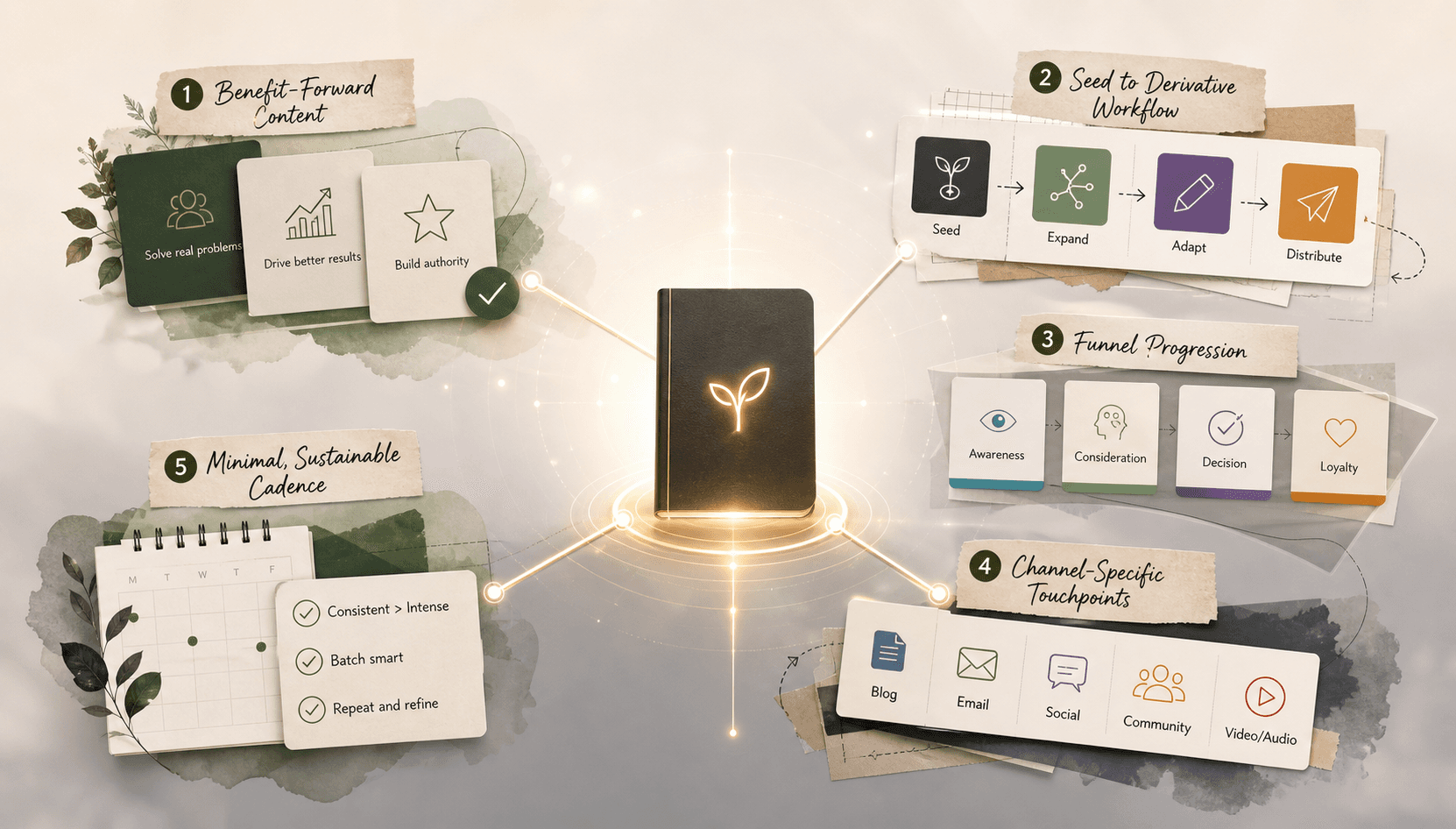
That idea is what ties the whole collection together. The five articles are not five isolated opinions. They form a system:
define the benefit
turn scattered observations into a strong source document
distribute the idea across the funnel
adapt the message to each touchpoint
keep the cadence minimal enough to sustain
In that sense, Bard School reads like a practical content doctrine for a guild that wants to stay sharp without becoming a content treadmill.
Start With Benefit, Not Identity
The first article, *Craft or Capture*, sets the tone for everything else. Its central move is to reject content that exists mainly to tell the world how cool "we" are. Instead, it pushes a benefit-forward frame: give people something useful, immediate, and low-friction. Educate them, entertain them, or elevate how they see a problem. If the audience has to work too hard to find the value, the piece is already weaker than it should be.
That matters for RaidGuild because the guild already produces insight in the course of doing real work. The challenge is not whether there is anything worth saying. The challenge is whether that insight gets shaped into something another person can actually use. Bard School’s answer is to treat communication as a craft of reducing entropy: isolate the value, frame it clearly, and deliver it with as little drag as possible.
Build a Seed, Then Mine It
The second article, *Mining Impulse for Gold*, makes the system operational. Its core idea is that content work should begin with accumulation. Buckets hold fragments: links, screenshots, observations, call notes, debates, rants, and half-formed ideas. From those buckets, someone produces a long-form "seed" with a real thesis. That seed is not the end product. It is the source material for everything else.
This is one of the strongest ideas in the collection because it solves two RaidGuild-sized problems at once. First, it gives the guild a way to capture distributed intelligence without requiring everyone to become a polished writer. Second, it treats derivatives as a feature, not a compromise. Tweets, newsletter sections, Discord summaries, videos, talks, and offers are not separate creative burdens. They are different expressions of the same core argument.
That makes the workload feel more modular and more realistic. Instead of inventing every post from scratch, the guild can process one useful insight deeply and then let it travel.
Move People From Curiosity to Trust
The third article, *Understanding a Marketing Funnel*, gives the collection its directional logic. Bard School does not use the funnel as a vague marketing buzzword. It treats it as a structured path that moves people from mild curiosity to trust, then into engagement, action, and longer-term relationship.
That framing is especially useful for RaidGuild because different channels are often asked to do the wrong job. A top-of-funnel touchpoint should not behave like a pitch deck. A newsletter should not read like a vague brand slogan. An intake page should not leave the reader guessing what happens next. The collection keeps returning to one discipline: each layer should offer a clear benefit, ask for only the next reasonable step, and avoid unnecessary cognitive load.
This is also where the benefit-forward principle becomes more than a writing preference. It becomes a routing principle. Good content does not just get attention. It helps the right people move closer with less friction.
Match the Message to the Channel
The fourth article, *Specific Touchpoint Instructions*, translates the funnel into channel behavior. It treats YouTube, Twitter, the website, and the newsletter as distinct tools with distinct jobs. The point is not to post everywhere for the sake of volume. The point is to understand what each surface is for.
In this model, YouTube acts as an archive and proof-of-work layer. Twitter shapes public positioning in real time. The website converts discovery into clarity and the next action. The newsletter builds trust density with more depth and directness. Each touchpoint has different success signals, different levels of intimacy, and different expectations from the audience.
This is a helpful correction for any team that tends to collapse "content" into one generic practice. Bard School insists on channel-specific touchpoint strategy: no vague hype, no bait, no filler, no accidental calls to action. Every surface should know its job.
Prefer a Cadence You Can Actually Keep
The fifth article, *Minimal Content Doctrine*, may be the most immediately actionable for RaidGuild. It argues for a minimal sustainable cadence: one seed per month, with derivatives built from that seed, plus a lightweight weekly presence. The point is not to dominate every channel. The point is to keep the funnel alive without burning out the people doing the work.
That restraint is part of what makes the collection feel credible. Bard School is not telling a dev guild to become a full-time media company. It is arguing that consistency matters more than volume, and that a modest recurring system beats ambitious chaos. One clear seed with a thesis can support a newsletter, a few tweets, a video or archive artifact, and internal Discord coordination. That is enough to create continuity if the signal is real.
The Collection Works Best as One Doctrine
The real strength of Bard School is the connective tissue between its parts.
*Craft or Capture* says the audience benefit comes first. *Mining Impulse for Gold* says gather raw material and consolidate it into a seed. *Understanding a Marketing Funnel* says move people from curiosity to trust in stages. *Specific Touchpoint Instructions* says adapt the message to each channel’s job. *Minimal Content Doctrine* says keep the whole system small enough to sustain.
Taken together, that becomes a practical doctrine for content that is useful, coordinated, and non-theatrical. It also fits RaidGuild’s current moment unusually well. The guild does not need a bigger brand performance. It needs clearer traces: ideas that make it easier for the right people to understand the work, trust the thinking, and take the next step.
That emphasis on human coordination also echoes recent guild conversation. In a May 15, 2026 cohort voice session, one participant framed the need plainly: "You've spent all day building with an AI... come to RaidGuild and build with humans." That line lands because it points to the same underlying problem Bard School is trying to solve from the content side. In a noisier environment, better signals are not just promotional assets. They are coordination tools.
Practical Takeaways for RaidGuild
The immediate use case is straightforward.
RaidGuild can treat Bard School as a working model for content and news output:
start by choosing one theme or bucket worth developing now
produce one seed with a clear thesis and concrete reader benefit
mine that seed into derivatives for the channels that matter
make each touchpoint do one job well
measure success by qualified conversations, replies, references, and trust, not just reach
keep the cadence minimal enough that it survives normal guild life
If that discipline sticks, the upside is larger than "better marketing." It creates a reusable way to turn guild learning into public clarity, internal alignment, and durable knowledge. That is exactly why this collection is worth surfacing now that it has landed in Prism Knowledge.
Source Notes / Further Reading
Bard School collection author: @elco8100 / amateurprophecy.eth / https://www.elementarycomplexity.com
Craft or Capture: https://amateurprophecy.eth.link/bardschool/craftorcapture/
Mining Impulse for Gold: https://amateurprophecy.eth.link/bardschool/practicalconsiderations/
Understanding a Marketing Funnel: https://amateurprophecy.eth.link/bardschool/funnel/
Specific Touchpoint Instructions: https://amateurprophecy.eth.link/bardschool/touchpoints/
Minimal Content Doctrine: https://amateurprophecy.eth.link/bardschool/calendar/
Meeting quote source: Prism memory artifact 20260515_171700Z-discord-voice-d8c215df, created 2026-05-15T17:17:00Z.
Have a project in mind?
Start a conversation with RaidGuild
Tell us what you are building and where the guild could help.
Make a general inquiry