
The Atomized Developer
Author
Date Published
Spencer Graham is building a personal CRM, but the interesting part is not the CRM.
The interesting part is what kind of problem he thinks it is.
During a June Cohort Fireside with RaidGuild, Spencer described a small, self-hosted system for keeping track of the people in his life: family, friends, professional collaborators, and all the relationships that have blurred together after years of building in crypto communities. The goal is not sales pipeline hygiene. It is not another inbox. It is a private memory system for noticing what matters and remembering when to follow up.
That distinction changes the shape of the whole conversation. A personal CRM can sound like one more productivity trick until it becomes a question about care: who do you want to stay connected to, what do you want to remember, and how much of your social life should be handed to software you do not control?
Spencer's answer, at least for now, is to build the thing himself. His current system pulls from personal communication streams like messages, email, and meeting transcripts. He is thinking about graph-shaped data, relationship events, and inference jobs that could remind him later when someone mentioned a birthday, a surgery, a wedding, or some other human fact that should not disappear into the scroll.
There is a joke hiding in here, and someone in the chat found it: builders will really make an AI-powered personal CRM before adding family birthdays to a calendar. Fair. But the joke lands because the project is also serious. Spencer is not trying to optimize strangers into leads. He is trying to remember people without pouring his whole digital life into somebody else's server.
That was the first thread of the fireside: personal software as relationship infrastructure.
The second thread was how Spencer builds now.
He described an agentic coding workflow where he does not necessarily drive every tool directly. A coordinator can send work into planning, implementation, and review loops. Codex can appear as a reviewer. Subagents can work through plans and implementations until checks pass. Deterministic tests and pre-push checks still matter. The loop is not simply "ask an AI to write code." It is closer to a small workshop of agents, reviewers, and guardrails arranged around a human intent.
That sounds futuristic until Spencer gets to the hard part: interfaces for humans.
A backend check can pass. A plan can survive review. A code change can be mechanically correct. But when the work has a human-facing surface, the question becomes harder: does this feel right, does it make sense, can someone actually use it, did the interface preserve the intention? Spencer talked about exploring a UX QA agent that could run on a schedule or after pushes, inspect an application, open issues, and maybe someday fix them. Even then, the hard part is telling the agent what to look for.
This is where the fireside became less about tools and more about coordination.
Agentic workflows increase individual leverage. A builder with private context, local memory, and a stack of agents can move quickly. They can turn intention into code, code into review, review into another iteration. They can build a personal system to remember relationships and another system to ship software.
But Spencer kept circling the thing that might get lost.
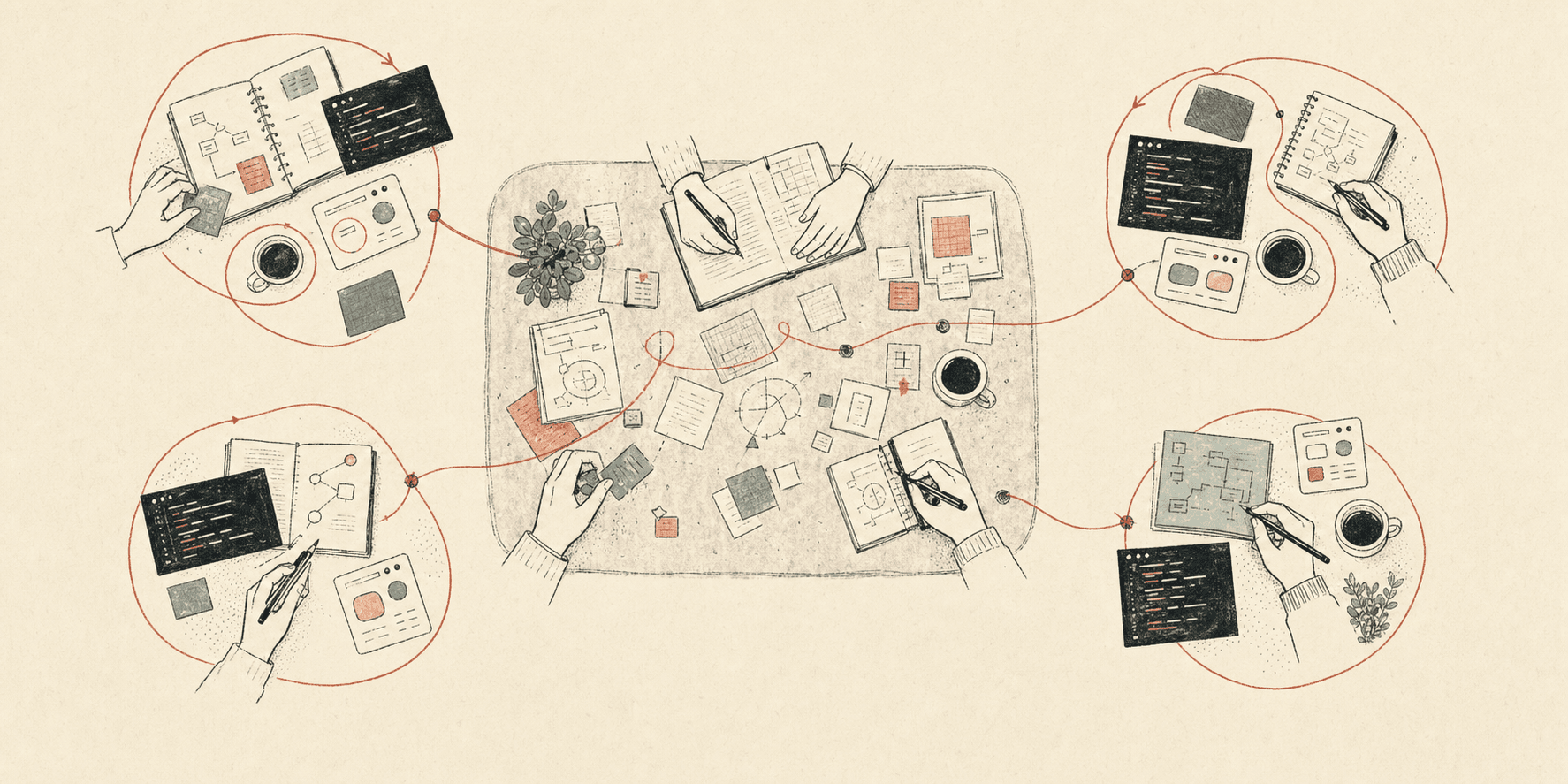
Working on a project with other people has never been only about the output. It bundles the thing being built with the relationships formed while building it. Shared context, arguments, jokes, rituals, trust, taste, and the slow accumulation of knowing how someone thinks all become part of the work. A good team is not just a parallel compute cluster made of humans. It is a social object.
When more work moves through private agents, that bundle can loosen.
The output may still happen. Maybe it happens faster. The issue gets closed, the branch gets merged, the artifact appears, the agent reports success. But the shared context may be thinner. The argument that would have happened in a room becomes a prompt. The moment where two people develop taste together becomes a private review loop. The small frictions that create alignment get optimized away before anyone notices what they were doing.
That is the anxiety inside the phrase one participant dropped into chat: the atomized developer.
The atomized developer is not powerless. That is the point. They may be more capable than ever. They have agents, memory, scripts, reviewers, and enough automation to run a small software factory from a laptop. What they may not have is the same density of shared context with other people.
Spencer is not arguing against the tools. He is using them. The personal CRM and the coding loop are both attempts to work with the new terrain honestly. One tries to make relationship memory more intentional. The other tries to make software work more reliable. Both accept that AI is becoming part of the builder's everyday environment.
The question is what kind of environment we let it become.
For RaidGuild, this is not abstract. Raids have always been more than delivery mechanisms. They are how people learn each other's standards, find collaborators, build reputation, and turn temporary work into longer-lived trust. The guild model depends on the bundle: useful work plus shared context plus relationships that outlive a single project.
If agents make individual output cheaper, the social layer does not become less important. It becomes easier to neglect.
That may be the real field note from Spencer's fireside. The next coordination problem is not just giving every builder a better agent. It is preserving the reasons people wanted to build together in the first place.
A personal CRM can help one person remember who matters. A reviewer loop can help one person ship better work. A UX QA agent might help one person catch what their tests miss.
The harder system is still the shared one: the place where context is visible, judgment is developed in common, and the work remains attached to the relationships that make it meaningful.
The atomized developer is coming from inside the workshop. The task now is not to stop them. It is to make sure they still have somewhere to gather.
Have a project in mind?
Start a conversation with RaidGuild
Tell us what you are building and where the guild could help.
Make a general inquiry