
Proxy Collapse Came For The Reflection Paper
Author
Date Published
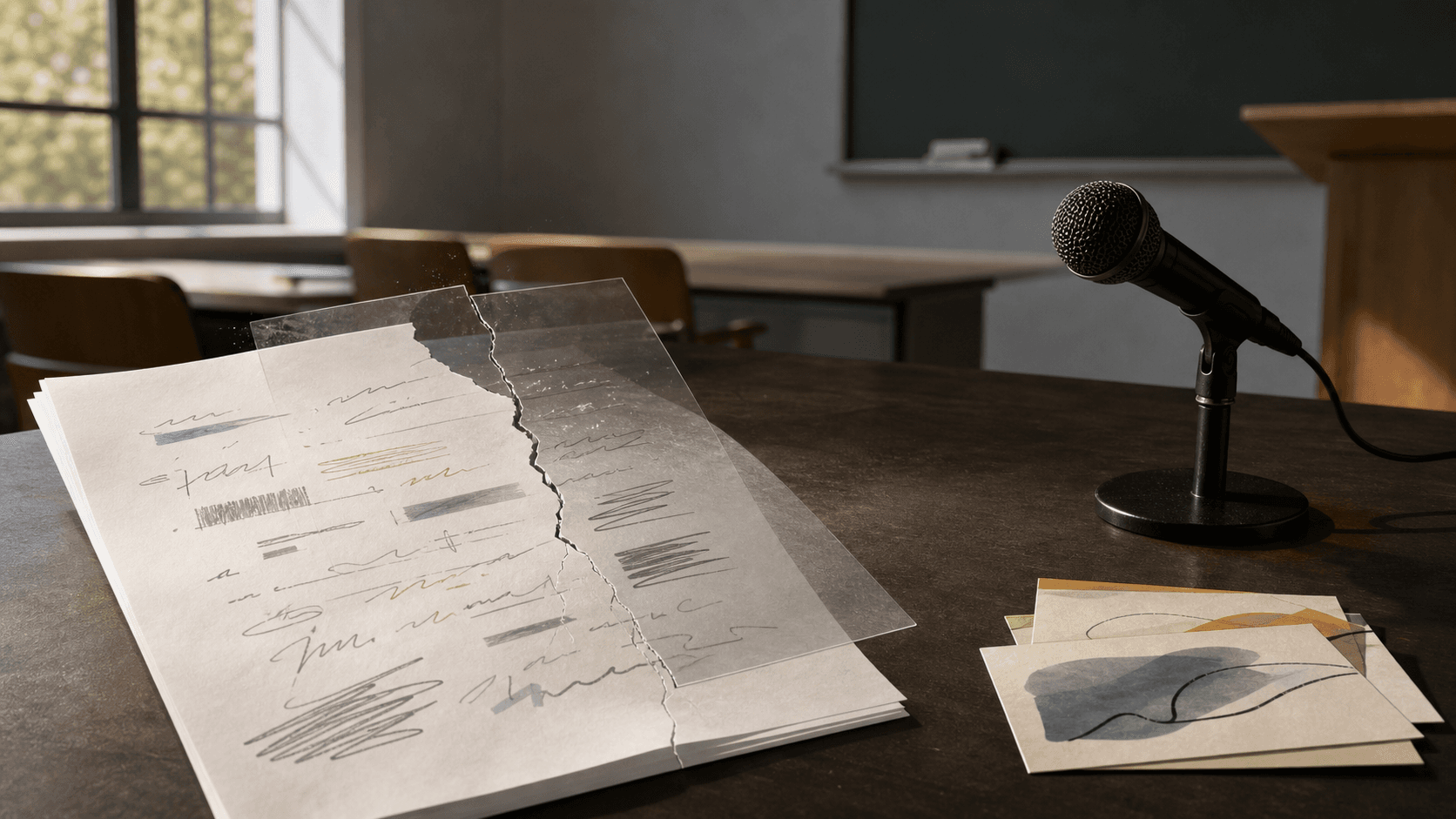
There is a quiet bargain inside a lot of schoolwork: the thing a student turns in is not the thing we actually care about.
The reflection paper is the cleanest example. Nobody assigns a reflection paper because the world needs another two pages of tidy student prose. The paper is supposed to stand in for something harder to see: did the student read, think, connect the idea to their own experience, and come away with enough understanding to say something back?
For a long time, that bargain mostly held because faking the artifact took work. You could bluff, but even bluffing required enough reading, enough sentence-making, enough friction, that the paper still carried some signal. The submitted document was never the same thing as understanding. It was a proxy. It was just a proxy with a cost attached.
Kerp put a name to the breakage in a recent cohort fireside: proxy collapse. AI makes the old proxy cheap enough that it stops proving what it used to prove. As he framed it, AI breaks the point where it was once too costly to fake the thing.
That lands harder than the usual cheating panic because it moves the problem to the right layer. The issue is not simply that students can generate text. The issue is that a format we were already using indirectly has become too weak to carry the weight we put on it.
A written reflection can still be useful. Writing can still clarify thought. But if the assessment depends on the existence of polished prose as evidence that understanding happened, the signal is now compromised. The old artifact can be produced without the old path.
That does not mean the answer is to ban the tool and rebuild the same assignment inside a higher wall. It means the assessment has to move closer to the thing being assessed.
In the fireside, Kerp pointed toward interview-style assessment and oral exams as one path back to signal. Not oral exams in the nostalgic, professor-across-the-desk sense. His class sizes make that unrealistic. The interesting turn is using AI on the assessment side too: a Claude-based interview skill that can ask students questions, follow up, probe weak spots, and test whether they can actually explain the material.
That flips the AI conversation in education from detection to design.
Detection asks: did the student use AI to make this artifact?
Design asks: what kind of artifact, interaction, or defense would show us the understanding we actually care about?
Those are different questions. The first one keeps the reflection paper at the center and tries to restore its old authority. The second admits the authority was always borrowed. The paper mattered because it gave teachers a workable view into a student's thinking. If that view is fogged, build another window.
For builders, this is familiar terrain. We have all seen proxy collapse somewhere. GitHub stars stand in for quality until the incentives distort. Meeting attendance stands in for contribution until people learn how to be present and absent at the same time. A polished deck stands in for product judgment until the demo breaks. Any proxy can work for a while. Any proxy can rot once the cost curve changes.
AI is not special because it creates proxy collapse from nothing. It is special because it drops the cost of producing convincing artifacts across many domains at once. School just feels the pressure early because school has always needed scalable ways to infer invisible learning from visible work.
The better response is not to mourn the paper. It is to get more honest about what the paper was doing.
If the goal is reflection, maybe students should have to defend the reflection live. If the goal is reading, maybe the assessment should include a conversation that moves through specific claims and counterclaims. If the goal is transfer, maybe the student should apply the idea to a new case and explain why the fit holds.
The point is not that every assignment becomes an interrogation. The point is that once production gets cheap, explanation gets more valuable. Process gets more valuable. The ability to respond, revise, connect, and defend gets more valuable.
That is the useful lesson hiding under the education anxiety. AI did not kill the reflection paper. It exposed the part we were trusting too much.
The work now is to build assessments that can survive contact with cheap fluency.
Have a project in mind?
Start a conversation with RaidGuild
Tell us what you are building and where the guild could help.
Make a general inquiry